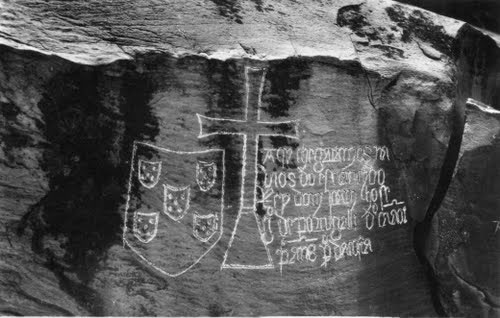
Inscription dated 1485 by Diogo Cão, near the falls
of Lelala around Matadi: "Aqui chegaram os navios
do esclarecido rei D.João II de Portugal - Diogo Cão,
Pero Anes, Pero da Costa." ("Here arrived the ships
of king John II of Portugal – Diogo Cão, Pero Anes,
Pero da Costa”.
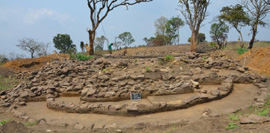
Ruins of the Ngongo Mbata church (DRC) dated
AD 1625-1650, excavated by the KongoKing
project
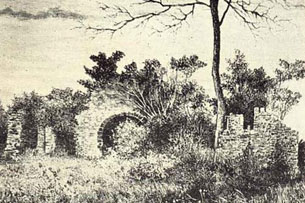
Ruins of the Mbanza Kongo cathedral before
restoration (in 1886)
KONGOKING project
Full project title: Political centralization, economic integration and language evolution in Central Africa: An interdisciplinary approach to the early history of the Kongo kingdom.
The history of the Kongo area has been more thoroughly studied than that of any other region in Central Africa. We have unequalled insights in the area’s history of the last 500 years. There is a considerable body of historical literature covering the entire time span, completed with an even more important body of ethnographical, anthropological and art historical literature for the more recent periods.
Although Kongo history is well studied after 1500, very little is known about the origins and earlier history of the kingdom. The wider region of the Kongo kingdom is virtually unknown archaeologically. Systematic archaeological research on the origins of the kingdom has never been conducted. The research team will therefore undertake pioneer excavations in several capital sites of the old kingdom, both in Angola and the Democratic Republic of Congo.
Similarly, no comprehensive historical linguistic study has covered the languages in the area of the Kongo and closely affiliated kingdoms. Nonetheless, the earliest written documents with Bantu language data, going back to the early 17th century, originate from this region, and are readily exploitable. The research team will therefore undertake a historical-comparative study of the Kikongo dialect cluster and surrounding language groups, such as Kimbundu, Teke and Punu-Shira, systematically comparing current- day data with data from the old documents. Special attention will be given to cultural vocabulary related to politics, religion, social organization, trade and crafts such as metallurgy and pottery, which in conjunction with the archaeological discoveries, will shed new light on the origins, rise and development of the Kongo kingdom.
Due to the region’s rich historical tradition, it will also be possible to examine how political centralization and economic integration influenced language evolution and how these key macro-historical processes are reflected in the archaeological record. From a general methodological point of view, this approach will allow us to test correlations between historical, linguistic, archaeological and ethnographical data and thus to enhance interdisciplinary methods to study early history in other parts of Central Africa, which lack such a long historical tradition.