

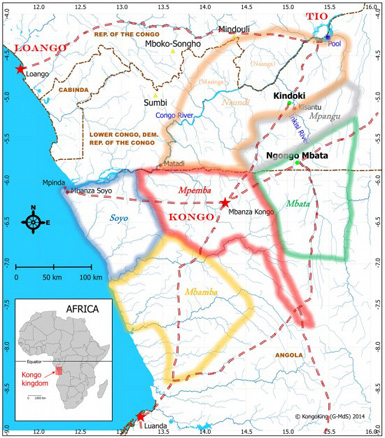
Kongo kingdom map showing its extension during the
16th-17th centuries (© KongoKing project).
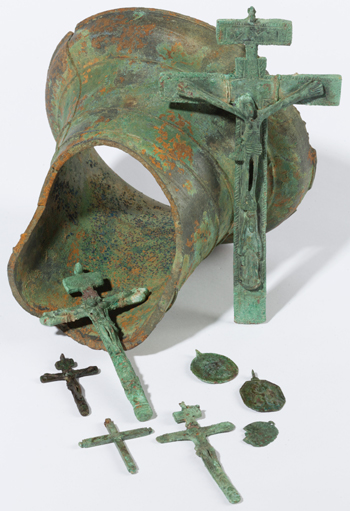
Religious artefacts found during excavations at the Ngongo
Mbata and Kindoki sites by the KongoKing project.
Bronze church bell, copper crucifixes and cross, religious
medals, all dated early 17th to early 19th centuries
(© IRPA/KIK)
KONGOKING : an interdisciplinary approach to the origins of the Kongo kingdom
KONGOKING is an interdisciplinary and interuniversity research group which aims at contributing to a better understanding of the origins and early history of the Kongo kingdom. Funded by a Starting Grant of the European Research Council under the Seventh Framework Programme (FP7), KONGOKING is coordinated by Prof. Koen Bostoen of Ghent University and unites researchers from Ghent University (UGent), Brussels University (ULB) and the Royal Museum for Central Africa in Tervuren (RMCA), as well as from several partner institutions in Africa, Europe and the USA.
The magnificent Kongo kingdom, which arose in the Atlantic Coast region of Equatorial Africa, is a famous emblem of Africa’s past. It is an exceptionally important cultural landmark for Africans and the African Diaspora. Thanks to its early involvement in the Trans-Atlantic trade and its early introduction to literacy, the history of this part of sub-Saharan Africa from 1500 onwards is better known than most other parts of Africa. At the same time, still very little is known about the origins and early history of the kingdom.
The interdisciplinary KONGOKING team therefore wants to shed new light on the origins, rise and development of the Kongo kingdom. Archaeology and historical linguistics, two key disciplines for the reconstruction of early history in Africa, play the most prominent role in their innovative approach.
Languages of Africa
Most languages spoken in Africa belong to one of three large language families: Afroasiatic, Nilo-Saharan and Niger–Congo. Another hundred belong to small families such as Ubangian (sometimes grouped within Niger-Congo) and the various families called Khoisan, or the Indo-European and Austronesian language families mainly spoken outside Africa; the presence of the latter two dates to 2,600 and 1,500 years ago, respectively. In addition, the languages of Africa languages include several unclassified languages and sign languages.
The earliest Afroasiatic languages are associated with the Capsian culture, the Nilo-Saharan languages are linked with the Khartoum Mesolithic/Neolithic, the Niger-Congo languages are correlated with the west and central African hoe-based farming traditions and the Khoisan languages are matched with the south and southeastern Wilton industries. More broadly, the Afroasiatic family is tentatively grouped within the Nostratic superfamily, and the Nilo-Saharan and Niger-Congo phyla form the Niger-Saharan macrophylum.
Afroasiatic languages
Main article: Afroasiatic languages
Comments on Reddit
Afroasiatic languages are spoken throughout North Africa, the Horn of Africa, Western Asia and parts of the Sahel. There are approximately 375 Afroasiatic languages spoken by over 350 million people. The main subfamilies of Afroasiatic are Berber, Chadic, Cushitic, Egyptian and Semitic. The Afroasiatic Urheimat is uncertain. However, the family's most extensive branch, the Semitic languages (including Arabic, Amharic and Hebrew among others), seems to have developed in the Arabian peninsula. The Semitic languages are now the only branch of Afroasiatic that is spoken outside Africa.
Some of the most widely spoken Afroasiatic languages include Arabic (a Semitic language, and a recent arrival from West Asia), Somali (Cushitic), Berber (Berber), Hausa (Chadic), Amharic (Semitic) and Oromo (Cushitic). Of the world's surviving language families, Afroasiatic has the longest written history, as both the Akkadian language of Mesopotamia and Ancient Egyptian are members.
Nilo-Saharan languages
Main article: Nilo-Saharan languages
Nilo-Saharan languages consist of a hundred diverse languages. The family has a speech area that stretches from the Nile Valley to northern Tanzania and into Nigeria and DR Congo, with the Songhay languages along the middle reaches of the Niger River as a geographic outlier. Genetic linkage between these languages has not been conclusively demonstrated, and among linguists, support for the proposal is sparse. The languages share some unusual morphology, but if they are related, most of the branches must have undergone major restructuring since diverging from their common ancestor. The inclusion of the Songhay languages is questionable, and doubts have been raised over the Koman, Gumuz and Kadu branches.
Some of the better known Nilo-Saharan languages are Kanuri, Fur, Songhay, Nobiin and the widespread Nilotic family, which includes the Luo, Dinka and Maasai. The Nilo-Saharan languages are tonal.
Niger–Congo languages
Main article: Niger–Congo languages
The Niger–Congo languages constitute the largest language family spoken in Africa and perhaps the world in terms of the number of languages. One of its salient features is an elaborate noun class system with grammatical concord. A large majority of languages of this family are tonal such as Yoruba and Igbo, Ashanti and Ewe language. A major branch of Niger–Congo languages is the Bantu phylum, which has a wider speech area than the rest of the family (see Niger–Congo B (Bantu) in the map above).
The Niger–Kordofanian language family, joining Niger–Congo with the Kordofanian languages of south-central Sudan, was proposed in the 1950s by Joseph Greenberg. Today, linguists often use "Niger–Congo" to refer to this entire family, including Kordofanian as a subfamily. One reason for this is that it is not clear whether Kordofanian was the first branch to diverge from rest of Niger–Congo. Mande has been claimed to be equally or more divergent. Niger–Congo is generally accepted by linguists, though a few question the inclusion of Mande and Dogon, and there is no conclusive evidence for the inclusion of Ubangian.